![Jerry white[4502].png](https://static.wixstatic.com/media/97dedd_db2e509143b44db19cc136127c362662~mv2.png/v1/fill/w_296,h_99,al_c,q_85,usm_0.66_1.00_0.01,enc_avif,quality_auto/Jerry%20white%5B4502%5D.png)


THERES NO NEED TO GUESS WHAT SIZE HVAC SYSTEM YOU NEED ANYMORE, LET US GET IT RIGHT FOR YOU THE FIRST TIME!
OUR PRODUCT IS COMFORT
What Is Comfort?
A comfortable indoor environment is one that is pleasant to the senses — not offensive to touch, smell, sound, or sight. Achieving this comfort depends largely on how efficiently heat is transferred between the human body and its surroundings. The key factors that influence this process are temperature, airflow, and humidity.
How Do You Know What Size HVAC System You Need?
Do you guess? Go with a "rule of thumb"?
You shouldn’t.
The first and most important step before purchasing any HVAC system should always be a load calculation. This calculation considers various aspects of your home — such as size, insulation, number of windows, and local climate — to determine the right system capacity needed to maintain comfort year-round.
Have you ever noticed your HVAC system struggling on the hottest day of summer or the coldest day of winter?
Your home feels too hot or too cold, and the system just can’t keep up.
If that sounds familiar, chances are your air conditioning or heating system was not properly sized — or worse, not sized at all.
Don’t leave comfort to chance. Proper sizing ensures your HVAC system runs efficiently, keeps your home comfortable, and saves you money in the long run
How Do
All EffICIENCY BEGINS WITH A LOAD CALCULATION

Why A load calculation? and how my building effects the load calculation
Load
Load calculations are essential for determining the amount of heat gained or lost through a building's envelope during different seasons—heat gain in summer and heat loss in winter.
By performing a load calculation, you can determine exactly how many British Thermal Units (BTUs) and how much Cubic Feet Per Minute (CFM) of airflow are required to properly condition a room or an entire house. This information is crucial for assessing the energy consumption of an
HVAC system.
Improperly sized equipment can lead to significant inefficiencies. Oversized systems reduce efficiency, increase operating costs, and make it difficult to control indoor conditions—particularly humidity. On the other hand, undersized equipment struggles to meet the load during design conditions, runs continuously, and wastes energy.
Since design conditions—peak heating or cooling loads—only occur a few times each year, correctly sized equipment typically operates at partial capacity. Oversizing exacerbates this issue, causing the system to run inefficiently year-round.
Several factors influence the rate at which heat enters or exits a building, including the types of construction materials, insulation, windows, doors, number of occupants, internal heat gains, air infiltration, geographical location, building tightness, indoor and outdoor design temperatures, and the building’s orientation.
-
Provides Comfort and Humidity control at design conditions
-
Reduce possibility of mold and mildew
-
Reduce operating cost
-
Increased duct efficiency
-
Provides values for sensible and latent heat equipment capacity
-
Prevents oversizing and undersizing
-
Reduced installed cost
Benefits Of A Load Calculation
What We Do
At Jerico Aire, we specialize in heat loss/gain calculations and duct design drawings for residential buildings. We provide comprehensive HVAC design services to contractors, building owners, and architects. Our experienced team uses industry-approved software and follows ACCA standards, including Manual J, Manual S, and Manual D, to ensure every system is precisely calculated to meet each building’s specific load requirements.
MANUAL J
Manual J is the first and most essential step in HVAC system design. It outlines the requirements for accurately calculating a home’s heating and cooling loads. This includes evaluating key factors such as:
-
Ventilation requirements
-
Building material R-values
-
Building tightness and insulation
-
Window sizes and orientation
-
Local climate conditions
Manual J provides the total heating and cooling load and breaks it down into two components:
-
Sensible Heat Load – The amount of heat that must be added or removed to change the air temperature. This is the temperature you see on your thermostat.
-
Latent Heat Load – The amount of moisture that must be removed to maintain proper indoor humidity levels.
MANUAL S
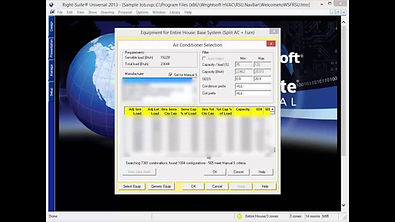
Manual S is the second step in the HVAC design process. It ensures that the heating and cooling equipment selected is properly sized to match the building’s design conditions calculated through Manual J.
Manual S focuses on choosing equipment that aligns with both the sensible and latent heat loads, which together make up the total system capacity. Proper selection guarantees:
-
Equipment is neither oversized nor undersized
-
Consistent comfort based on design temperature and humidity conditions
-
Energy efficiency and optimal system performance
Manual D addresses one of the most common problems in HVAC systems—improper airflow caused by oversized or undersized ducts, and the incorrect selection of grills, registers, and diffusers.
Manual D provides a detailed schematic of the ductwork system, including:
-
Supply and return duct locations and sizes
-
Branch duct routing
-
Inlet registers and outlet grille placements
Using the room-by-room load calculations from Manual J, Manual D determines how much CFM (Cubic Feet per Minute) of air is needed in each space to maintain comfort. This ensures balanced airflow, efficient operation, and consistent temperature distribution throughout the home.
Properly designed ductwork is essential to the overall performance of the HVAC system, and Manual D makes that precision possible.
MANUAL D


ABOUT US
Our team is made up of experienced professional designers with over 15 years of experience whose job doesn't end when the HVAC design is completed. Throughout the installation process, we follow up on each job to provide assistance and on-site consulting.
For new buildings a set of blueprints are needed to begin the design process. For existing buildings, buildings under renovations and add-ons; site visits are made to determine conditions. Projected time estimates starts when all documents have been received.
There are many factors that determine the size of your Heating/cooling equipment.
-
Window types- single pane, double pane, triple pane, low-e, window shading, direction windows face
-
Building tightness- leaks through doors, windows and the buildings structure
-
Occupants, pets, plants
-
Appliances, lights
-
Building Materials
-
Insulation (Exterior walls, Roof) and insulation values (R-values)
-
Building overhangs
-
Duct leakage, duct location, duct material, duct material R-values
-
Number of exposed walls
-
Mechanical Ventilation
The HVAC design is only as accurate as the information you provide during the submission process.

Air conditioning and heating system not only absorbs a large portion of a home's overall energy expenditure, but it also has the greatest effect on the occupants' health and comfort of any other system in the building. Since air conditioning systems play such a significant role in a home's success, it's critical that they get enough "design" attention to ensure that they work as well as possible.
![Jerry white[4502].png](https://static.wixstatic.com/media/97dedd_db2e509143b44db19cc136127c362662~mv2.png/v1/fill/w_230,h_77,al_c,q_85,usm_0.66_1.00_0.01,enc_avif,quality_auto/Jerry%20white%5B4502%5D.png)